
For any car enthusiast or DIY lover, the garage is more than just a place to park a car. It is a sanctuary. It is where engines are rebuilt, oil is changed, and projects come to life. However, turning a standard residential garage into a fully functional mechanic’s workshop requires more than just parking a toolbox in the corner.
Creating a professional-grade workspace involves strategic planning, smart organization, and the right equipment. Whether you are performing routine maintenance on the family SUV or restoring a classic muscle car, this guide will walk you through every step of mastering your space.

Assessing Your Garage Space
Before you buy a single tool or workbench, you need to understand the canvas you are working with. Most residential garages are designed for storage, not active work. Transforming this space begins with a critical assessment of the dimensions, limitations, and potential of the room.
Size and Dimensions
Get your tape measure out. You need to know exactly how much floor space you have when the garage door is closed and the car is parked inside.
-
Standard Two-Car Garage (20×20 to 24×24 feet): This is the “sweet spot” for most home mechanics. It offers enough width to open car doors fully while leaving room for workbenches along the walls.
-
Single-Car Garage: Space is at a premium here. Vertical storage and mobile workstations will be your best friends.
-
Ceiling Height: If you plan on installing a car lift, you typically need a ceiling height of at least 10 to 12 feet.
Layout and Obstacles
Look for the permanent features that will dictate your layout. Where is the water heater? Where are the support columns? Most importantly, consider the garage door tracks. The horizontal tracks that hang from the ceiling can limit where you place tall storage cabinets or overhead lighting.
Also, check your power sources. A mechanic’s garage needs more than the standard one or two outlets. You will need accessible power for air compressors, welders, and heavy-duty power tools, potentially requiring a 220V outlet installation.
Essential Tools for Your Ultimate Mechanic Set
A mechanic is only as good as their tools. While you can accumulate gear over a lifetime, there is a core set of equipment that every serious garage workshop needs to function effectively.
Basic Tools
Start with the foundation. These are the tools you will reach for 90% of the time:
-
Socket Sets: Invest in a comprehensive set that includes both metric and SAE (standard) sizes, along with deep and shallow sockets.
-
Wrenches: A full set of combination wrenches and ratcheting wrenches.
-
Screwdrivers and Pliers: Various sizes and types (needle nose, locking, slip joint).
-
Floor Jack and Jack Stands: Never rely on the emergency jack that came with your car. A high-quality hydraulic floor jack and sturdy jack stands are critical for safety.
Specialized Equipment
As your projects get more complex, your tool needs will evolve.
-
Air Compressor: This is the heart of a mechanic’s shop. It powers impact wrenches, air ratchets, and allows for tire inflation and parts cleaning. Look for a unit with a large enough tank (20+ gallons) to run tools continuously without the motor constantly cycling.
-
Pneumatic Tools: An air impact wrench can remove rusted lug nuts in seconds that would take hours by hand.
-
Diagnostic Scanner: For modern vehicles, an OBD2 scanner is essential for reading “Check Engine” lights and diagnosing sensor issues.

Optimal Garage Workshop Layout
An efficient workshop is all about workflow. You shouldn’t have to walk across the room to get a screwdriver. The “Golden Triangle” rule of kitchen design applies here too: keep your workbench, tool storage, and the vehicle bay in close proximity.
Tool Organization
Clutter is the enemy of productivity.
-
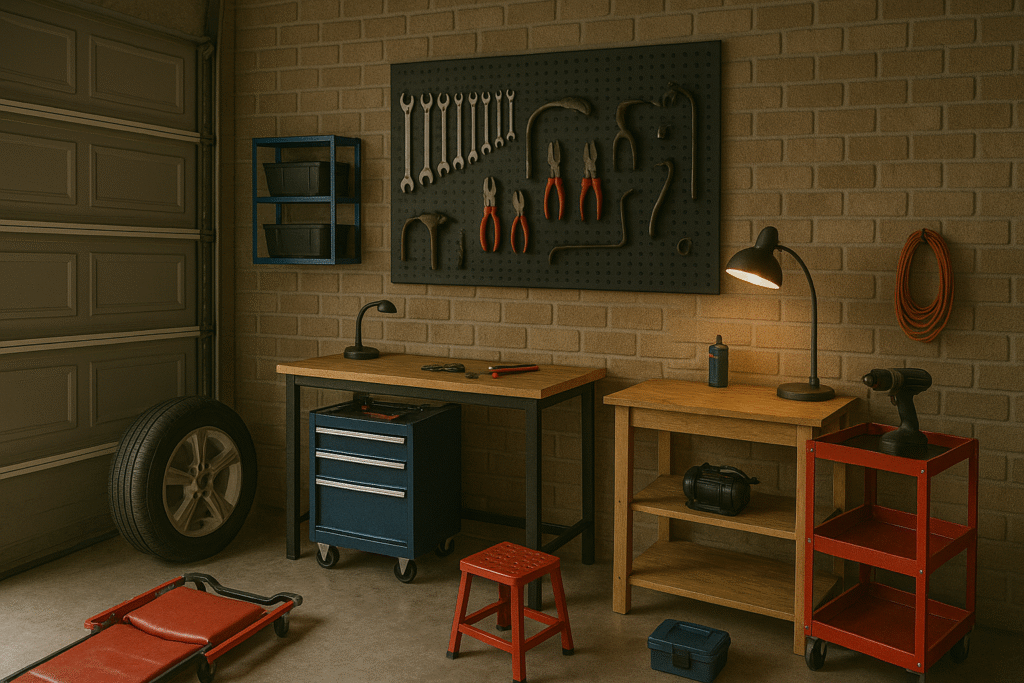
Pegboards: These are classic for a reason. They keep your most-used hand tools visible and within arm’s reach.
-
Tool Chests: A rolling tool chest is indispensable. It protects your tools from dust and moisture and can be moved right next to the car fender where you are working.
-
Shadow Boarding: Trace the outline of your tools on the pegboard or drawer liners. This way, you know immediately if a tool is missing before you close up shop.
Workbench Placement
Your workbench should be solid, heavy, and well-lit. Placing it against the back wall is standard, but if you have the space, a peninsula or island workbench allows you to access it from multiple sides. Ensure it has a vice mounted on one corner for holding parts steady.
Storage Solutions
You will need space for more than just tools. Fluids (oil, coolant, brake fluid), spare parts, and shop rags need a home.
-
Overhead Storage: Utilize the space above the garage door for long-term storage of items you don’t need often, like seasonal tires or roof racks.
-
Label Everything: Use clear bins and labels for nuts, bolts, and electrical connectors. Trying to find a specific 10mm bolt in a coffee can of mixed hardware is a nightmare.
Enhancing Your Garage Environment
You are going to be spending a lot of time here. Make it a space you actually want to be in.
Lighting
Most garage lighting is woefully inadequate. One dim bulb in the center of the room won’t cut it.
-
General Lighting: Install 4-foot or 8-foot LED strip lights to bathe the room in bright, white light (aim for 5000K color temperature).
-
Task Lighting: Add adjustable work lights over your bench and have a portable LED trouble light (or “wand”) for looking into engine bays.
Ventilation
Cars produce exhaust, chemicals produce fumes, and grinding produces dust.
-
Exhaust Fan: Install a high-velocity exhaust fan to pull fumes out.
-
Floor Fans: Keep air moving to stay cool in the summer.
-
CO Detector: This is non-negotiable. If you ever run an engine inside (even with the door open), have a carbon monoxide detector installed for safety.
Flooring
Concrete is porous and stains easily. Oil spills can become permanent eyesores.
-
Epoxy Coating: This is the professional standard. It is oil-resistant, easy to clean, and reflects light to brighten the room.
-
Interlocking Tiles: These plastic or rubber tiles snap together and are great for reducing fatigue on your feet.
-
Mats: At the very least, use anti-fatigue mats in front of your workbench.
Safety and Maintenance in Your Mechanic’s Garage
A workshop is full of hazards. Fire, heavy weights, and compressed air all pose risks.
Safety Gear
Keep a dedicated shelf or hook for your Personal Protective Equipment (PPE).
-
Safety Glasses: Wear them. Always.
-
Mechanics Gloves: Protect your hands from cuts, burns, and chemicals.
-
Fire Extinguisher: Mount a specialized extinguisher (Class B for oil/gas fires) near the exit.
Cleaning Supplies
Spills happen. Be ready.
-
Oil Dry/Kitty Litter: Keep a bag on hand to soak up large oil spills immediately.
-
Degreaser: Industrial-strength cleaner for floor spills.
-
Shop Rags: You can never have enough. Consider a laundry service or a dedicated rag bin.
Regular Maintenance
Just like your car, your shop needs tune-ups.
-
Drain the Compressor: Drain the water out of your air compressor tank weekly to prevent rust.
-
Inspect Jacks: Check your hydraulic jacks for leaks or cracks.
-
Organize Weekly: Take 15 minutes at the end of every week to put every tool back in its designated spot.
Upgrading Your Garage Workshop
Once you have the basics dialed in, you can start looking at the “dream” upgrades.
Car Lifts
If you have the ceiling height, a 2-post or 4-post lift changes everything. It allows you to work under the car standing up, saving your back and knees. A 4-post lift can also double your parking space by allowing you to stack one car over another.
Heating and Cooling Systems
In Florida, a garage can become an oven in the summer. Installing a Mini-Split AC unit is the ultimate luxury. It provides efficient cooling (and heating for those rare cold days) without the noise or security risk of a window unit. Insulation is key here—ensure your garage door is insulated to keep the cool air in.
Ready to Transform Your Garage?
Building a mechanic’s workshop is a journey. It starts with a clean floor and a socket set and evolves into a professional-grade space over years. But the most important component of any garage is the door itself. It needs to be secure, insulated, and reliable.
If you are planning a workshop upgrade, start with the entrance. Contact Garage Door On today to discuss insulated garage door options, high-lift tracks for car lifts, or side-mount openers to free up ceiling space for your new shop lights.
